
Scientific Publications.
Explore Culturon’s scientific publications, showcasing the extensive research underpinning our plasma-activated coating technology. With multiple peer-reviewed publications across leading journals, we continue to advance the science behind biomolecule–surface interactions and will share new work as it is published.


Biofunctional glass chamber slides: Plasma coatings enable long-term
reagent-free covalent functionalisation with diverse biomolecules
This publication details a scalable PAC-based approach for covalent functionalisation of glass chamber slides with proteins, signalling molecules, and glycosaminoglycans, enabling controlled biointerfaces for advanced cell culture and imaging applications.

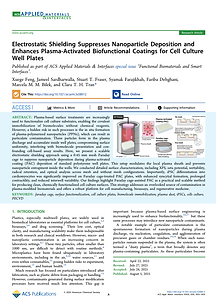
Electrostatic Shielding Suppresses Nanoparticle Deposition and
Enhances Plasma-Activated Biofunctional Coatings for Cell Culture
Well Plates
This publication details an electrostatic shielding strategy to suppress plasma-polymerised nanoparticle formation during PAC deposition, improving surface uniformity, biomolecule presentation, and reproducibility in cell-based assays.

Plasma processes for the creation of customizable bio-instructive surfaces and interfaces
This publication details how plasma processes enable the fabrication of customizable biointerfaces through covalent biomolecule immobilisation, providing control over biochemical, mechanical, and topographical cues for cell culture.

Plasma Activation of Microplates Optimized for One-Step Reagent-Free Immobilization of DNA and Protein
This study demonstrates that plasma-activated coating (PAC) enables one-step, reagent-free covalent immobilisation of DNA and proteins onto standard microplates. By generating surface radicals, PAC eliminates the need for complex chemical linking steps while achieving high-density, stable biomolecule binding. The resulting surfaces maintain optical clarity, support biomolecule functionality, and deliver consistent performance across high-throughput formats, highlighting PAC as a scalable and robust alternative to traditional surface modification methods.